
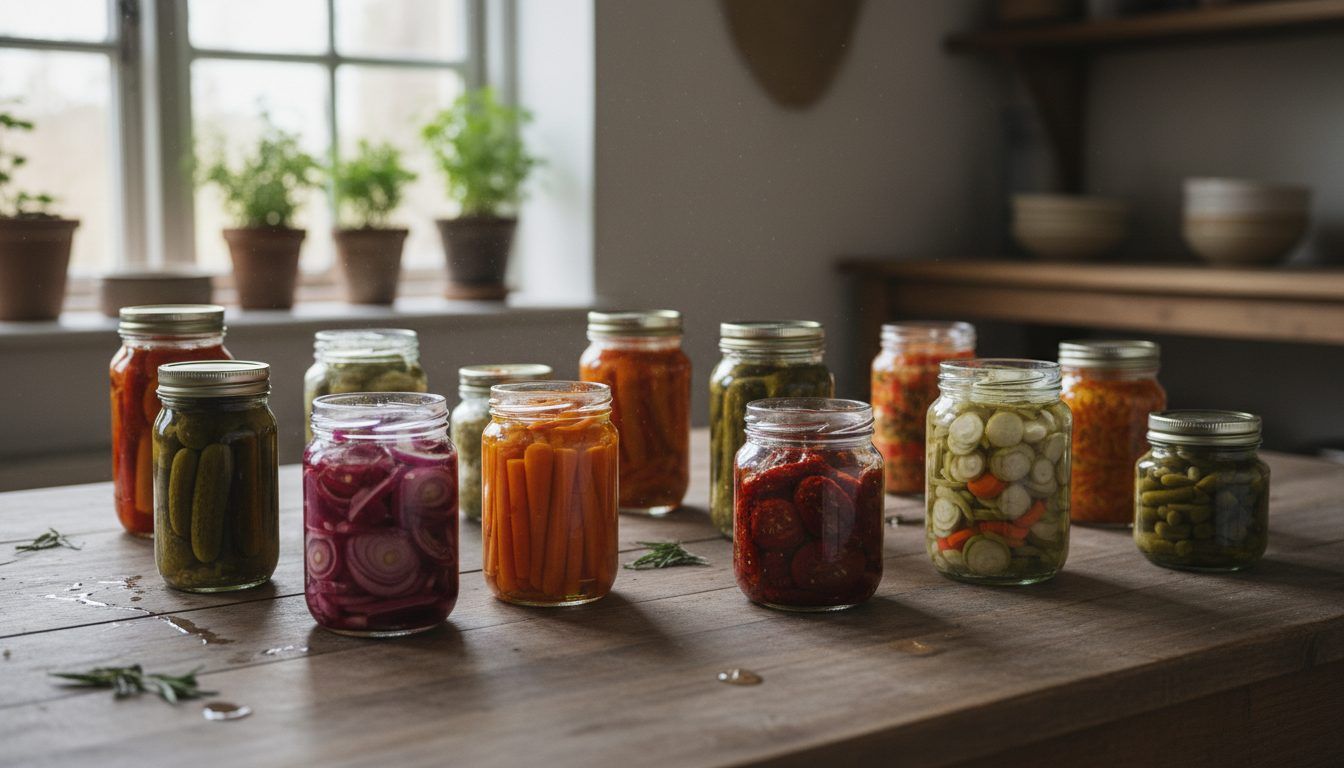
How to preserve winter stores without scales or a recipe: how many jars you get from 5 kg of tomatoes, peppers, and cucumbers
Ivan Lauc šest godina vodi Plodovi.hr. Inženjer robotike po struci, u kratke lance opskrbe hranom ušao je bez poljoprivrednog zaleđa i naučio ih iznutra - surađujući s više od 250 hrvatskih proizvođača, od malih OPG-ova do voćnjaka i pčelara. To ga je naučilo koliko sitnica odlučuje hoće li mali proizvođač preživjeti sezonu: kada se bere, koliko se stigne isporučiti u jednom danu i zašto cijena koju kupac vidi rijetko dođe do onoga tko je hranu uzgojio.
Why you need a ratio for preserves, not a recipe
When making preserves for winter, what you need above all is the ratio of raw produce to yield: how many jars of a certain volume come out of one box of vegetables. A recipe tells you how much salt and vinegar goes into a liter, but it doesn't tell you how many liters you'll actually get—and that is the piece of information that leaves people running out of jars halfway through.
Most cookbook recipes start with numbers nobody actually buys: 10 kg of tomatoes, 8 kg of peppers. The box that actually arrives at your doorstep is 5 kg, a crate from the farmers' market is 5 to 10 kg, and what you need is a way to turn that number into the number of lids you need to have in the house before you start.
We were interested in this figure for a practical reason. Across three August–September seasons, hundreds of kilograms of the same variety from the same OPG passed through our boxes, so we started logging what came out on the other side. Not as a laboratory measurement, but as a practical work log: how many liters of juice, how many jars of ajvar, how many cucumbers fit into a 720 ml jar.
5 kg of tomatoes: 3 to 3.5 liters of juice, or 4 to 5 jars of 720 ml
From 5 kg of tomatoes, you get about 3 to 3.5 liters of strained juice, which is 4 to 5 jars of 720 ml or 3 to 4 one-liter bottles. The 30 to 40 percent loss accounts for skins, seeds, and separated water, and the variation within that range is almost exclusively down to the variety.
Fleshy varieties like plum tomatoes (šljivar) and bull's heart (volovsko srce) give the highest yield of thicker juice and the least water separating at the bottom of the pot. Round salad tomatoes, the kind that are great in a salad, yield visibly more liquid and less pulp when strained. From the same weight, you get roughly the same volume in liters, but a thinner juice that separates a layer of water at the top after a few days in the jar. If you want thick passata or chopped tomatoes, look for a fleshy variety and ask the grower exactly which one they plant.
The practical implication: if you're planning 20 jars (720 ml) of juice, count on roughly 20 to 25 kg of tomatoes—so 4 to 5 boxes of 5 kg. For diced tomatoes, the loss is smaller because you only remove the skin, so 5 kg of fleshy tomatoes fills 5 to 6 jars of 500 ml.
- 5 kg of fleshy tomatoes (plum, volovsko srce): about 3.5 l of thick juice
- 5 kg of round salad tomatoes: about 3 to 3.2 l of thinner juice
- 5 kg of tomatoes for diced/canned tomatoes: 5 to 6 jars of 500 ml
- For 20 jars of 720 ml: 4 to 5 boxes of 5 kg
5 kg of peppers: 4 jars of stuffed peppers or 5 to 6 jars of ajvar
From 5 kg of bell peppers (babura), you get roughly 4 one-liter jars of pickled stuffed peppers or 5 to 6 jars of 500 ml of ajvar or roasted peppers in oil. The difference is huge because roasting and peeling removes about half the initial weight, whereas with peppers for pickling/stuffing you only lose the stem and seeds.
Size matters more than weight. In 5 kg of medium-sized bell peppers there are about 30 to 35 peppers, and a 1-liter jar fits 7 to 9 peppers if they are uniform and stacked upside down, nested into each other. If the box contains large peppers, you get fewer pieces and fewer jars, but more flesh per pepper—which is better for ajvar and worse for stuffing/pickling whole.
For ajvar and roasted peppers, flesh thickness is what matters, not size. Horn peppers (roga) and fleshy bell peppers with thicker walls yield a noticeably thicker paste and less water draining out after roasting. Thinner, paler peppers meant for stuffing are great in brine, but for ajvar they mean longer cooking down and a smaller final yield. When you buy a box with roasting in mind, it's worth saying so beforehand because a different variety is selected.
- 5 kg of medium bell peppers: about 30 to 35 pieces
- Pickled stuffed peppers: 4 jars of 1 l (7 to 9 peppers per jar)
- Ajvar / roasted peppers in oil: 5 to 6 jars of 500 ml
- Loss from roasting and peeling: about 50 percent of weight
5 kg of cucumbers: 5 to 6 jars of 720 ml, it all depends on size
Cucumbers are the most predictable because they aren't cooked or peeled, so 5 kg of gherkins measuring 6 to 9 cm fills 5 to 6 jars of 720 ml. The entire variation in yield comes down to size: smaller ones pack tighter so you fill fewer jars, while larger ones leave more empty space that gets filled by brine.
A 720 ml jar holds 12 to 15 gherkins of 6 to 8 cm vertically, or 7 to 9 cucumbers of 10 to 12 cm. If your box comes with mixed sizes, it pays to sort them into three piles first and pack jar by jar, because a jar with mixed sizes always ends up half-empty at the top—which is where cucumbers later float above the brine and soften.
For brine, count on roughly 300 to 350 ml per 720 ml jar for tightly packed gherkins, and up to 400 ml for larger cucumbers. That means for one 5 kg box, prepare about 2 liters of brine to have a reserve. Cucumbers larger than 12 cm aren't meant for whole jars; slice them into rounds or quarters for pickle salad, where 5 kg yields 6 to 7 jars of 720 ml because there are no empty air pockets.
- Gherkins 6 to 8 cm: 12 to 15 pieces per 720 ml jar
- Cucumbers 10 to 12 cm: 7 to 9 pieces per 720 ml jar
- Sliced into rounds: 6 to 7 jars of 720 ml from 5 kg
- Brine: about 2 liters per 5 kg box
How many days after harvest produce can still take pasteurization
Tomatoes and peppers reliably withstand pasteurization 2 to 3 days after harvesting; cucumbers ideally the same or next day, at most the second day. After that, the produce doesn't become unusable, but the texture changes: cucumbers lose their crunch, tomatoes bleed water, and roasted peppers yield a soggier paste.
Cucumbers are the most sensitive because after picking they quickly lose turgor—that internal pressure that makes them snap when you snap them in half. Once that snap is gone, it won't be there after pasteurization either, no matter how much vinegar and salt you use. That's why it pays to plan cucumbers as the first produce you process on the day they arrive, leaving tomatoes and peppers for the next day.
Tomatoes follow the opposite logic: if picked slightly before full ripeness, a day or two on the kitchen counter actually improves the juice as the sugars even out. What cannot wait is a tomato with cracked skin, which in the box is almost always harvested fully ripe. Process those first—they yield the thickest juice, but fermentation sets in earliest. Peppers can safely wait 3 to 4 days if kept in a cool, dry place, just don't wash them before storing.
How to plan winter preserves without a scale: number of boxes and number of lids
Start planning from the end: decide how many jars of a particular item you want in your pantry, divide by the yield per box, and you get the number of boxes to order. For 12 jars (720 ml) of juice that's 3 boxes of tomatoes; for 12 jars (500 ml) of ajvar, 2 boxes of peppers; for 12 jars of cucumbers, 2 boxes.
The second step is checking the number of jars and lids in the house. Always get 20 percent more lids than calculated, because a few won't seal properly in the end and you only find out the next day. The third step is scheduling the days: cucumbers on day one, tomatoes on day two, peppers on day three or four. That way, one delivery covers a whole weekend of preserving without rushing and without produce waiting around too long.
This kind of planning relies on one assumption: that you know what's actually arriving in the box. With us, boxes come from known OPGs and with known varieties, so before you order we can tell you whether this week brings fleshy plum tomatoes or round salad tomatoes, and what cucumber sizes are being harvested. That's the difference between buying 5 kg of vegetables and buying exactly what you need for the number of jars you have in mind.
Key takeaways
- From a 5 kg box of tomatoes, you realistically get about 3 to 3.5 liters of strained juice, or 4 to 5 jars of 720 ml, depending on whether the variety is fleshy or juicy.
- 5 kg of bell peppers yields about 4 one-liter jars of pickled stuffed peppers or 5 to 6 jars of 500 ml of ajvar and roasted peppers, as roasting loses roughly half the weight.
- 5 kg of gherkins (6 to 9 cm) fills 5 to 6 jars of 720 ml because cucumbers don't lose weight—they just pack more or less tightly.
- The most important factor isn't the recipe, but the harvest day: tomatoes and peppers withstand pasteurization 2 to 3 days after picking, cucumbers ideally the same or next day.
- When you know the kg-to-jar ratio, you buy the exact number of boxes and jars in advance, leaving no leftover raw produce or extra unused lids.
If you're planning your preserves for the last week of the season, it's useful to know when each item disappears from supply, which we covered in the article September in a box: 5 foods that disappear by September 20, because peppers and tomatoes don't share the same final week.
Frequently asked questions
How much vinegar and salt goes into cucumber brine?
A common working ratio is 1 part spirit vinegar (9 percent) to 3 or 4 parts water, plus 20 to 30 g of salt and optionally 20 g of sugar per liter of brine. For 5 kg of cucumbers, prepare about 2 liters of brine. A lower acidity gives a milder taste, but requires pasteurization and a cooler pantry.
Do jars need to be pasteurized if I fill them with hot contents?
With hot filling of tomato juice and ajvar, a vacuum often forms on its own and many consider that sufficient, but pasteurizing for 15 to 20 minutes at 85 degrees gives a much safer result, especially for low-acid spreads. Pickled cucumbers are pasteurized for a shorter time, 8 to 10 minutes, because longer cooking ruins the crunch. If the lid doesn't pop down after cooling, put the jar in the fridge immediately and eat it first.
How long do home preserves in jars last?
Properly pasteurized tomato juice, ajvar, and pickled cucumbers keep their quality for 12 to 18 months in a dark, cool pantry. After that, they are usually still safe, but color and texture noticeably deteriorate, especially with peppers. The rule is simple: finish last year's preserves before starting the new season.
Is it more cost-effective to buy a 5 kg box or loose vegetables for preserving?
For making preserves, a box is almost always better value per kilogram and, more importantly, provides uniform produce of the same variety and size from a single harvest. When buying loose items, you mix varieties, ending up with both fleshy and watery tomatoes in the same batch—yielding unpredictable volume and uneven juice thickness.
When is the best time of year to make preserves from tomatoes, peppers, and cucumbers?
Pickling cucumbers are best from late June to late August, tomatoes for juice and canned/chopped tomatoes from late July to mid-September, and peppers for ajvar and stuffing from late August to the first half of October. Produce is at its best during the peak of the season, when the price is lowest and fruit is at prime ripeness, with no post-harvest ripening during transport.